
Introduction
A sports facility business plan does two jobs. It persuades lenders and investors, and it tests whether your concept, market, building, and operating model can actually work together. Even owners who never plan to raise outside money need one.
The hard questions come early: Is there paying demand? Which facility model fits? What will construction and operations cost? How do you fill your hours, stay safe, and keep customers happy?
The SBA's guidance calls a plan a roadmap for structuring, running, and growing a business. This guide walks through market analysis, the business model, facility and operations, marketing, financials, technology, and the opening roadmap.
Key Takeaways
- Tie local market evidence to the sports, programs, pricing, and capacity you offer.
- Separate startup costs from operating expenses, working capital, and contingency.
- Model several revenue streams instead of leaning on one.
- Assign owners, milestones, and measurable assumptions so the plan stays useful after opening.
Build the Market Analysis and Business Model
Market analysis and your business model feed every other section of the plan. Write the executive summary last, once you can state the facility concept, target customers, sports offered, location, ownership structure, funding need, differentiators, and the headline financial goal.
Identify the Target Market and Unmet Demand
Start with data: Census figures, school enrollment, local clubs, employers, and recreation departments. The Census Bureau's Business Builder tool offers local demographic and economic data.
Interest in a sport is not the same as paying demand. 65% of U.S. kids ages 6-17 tried a sport in 2024, according to Project Play, but regular participation among ages 13-17 dropped 3%. Test whether families will pay for memberships, bookings, or programs.
A speed-and-agility academy applied this approach by counting over 300 high-school and 400 middle-school athletes within a 20-minute drive. It assumed about half of families could afford its prices and estimated 3-4% first-year capture, roughly 30 monthly members.

Define segments and what each needs:
- Youth athletes and parents: after-school slots, skill progression
- Adult recreational players: evenings, weekends, leagues
- Teams and clubs: block-booked practice time
- Schools, employers, municipalities: events, partnerships
Analyze Competitors and Position the Facility
Compare direct competitors, public and school facilities, and informal alternatives like a park field. Look at location, sports, hours, pricing, programs, amenities, online booking, and weaknesses.
Then run a SWOT. Strengths and weaknesses are internal; opportunities and threats are external. Let the results drive your positioning, pricing, partnerships, and launch priorities.
Define the Business Model and Revenue Streams
Map every revenue stream to the space, staff, equipment, schedule, and segment it needs:
- Memberships and court or field rentals
- Lessons, camps, and leagues
- Tournaments, parties, and team training
- Concessions, sponsorships, retail
A field rental at $100 an hour for two hours brings $200. A two-hour camp with 25-50 kids at $30 each brings $750-$1,500.
Write your value proposition in one sentence. List the assumptions to validate before you sign a lease, buy property, or break ground.
Plan the Facility, Operations, and Compliance
Start with a clear facility concept. Decide which sports you will offer, whether the site is indoor or outdoor, and how large the footprint needs to be.
Map the full program of spaces early:
- Courts or fields and training areas
- Spectator seating, reception, and locker rooms
- Storage, restrooms, concessions, and parking
- Accessibility routes and features required for your users
Choose a Location and Develop a Functional Layout
Evaluate visibility, parking, traffic, proximity to schools and population centers, utilities, lease or purchase terms, and room to expand. Do not treat a site as suitable until zoning and feasibility checks clear. Zoning rules vary: Arlington County, Virginia, allows indoor recreation by-right, by use permit, or by site plan depending on the district.
Compound Sports in Tampa took a little over a year to open, with zoning changes and architectural issues causing delays.
Your space-use plan should account for athlete flow, spectators, staff access, storage, safety zones, cleaning, and simultaneous programs. Dividers and multi-use areas add scheduling options if they don't compromise safety.

Plan Equipment, Staffing, and Daily Workflows
Budget by category, using vendor quotes rather than guesses:
- Sport-specific gear, flooring or turf, lighting, protective netting
- Scoreboards, fitness equipment, technology
- Furniture, cleaning supplies, first-aid resources, maintenance tools
Define roles across the operation:
- Ownership, management, and programming
- Coaching, front desk, sales, and marketing
- Maintenance, cleaning, finance, and safety
Plan hiring, training, background checks, contractor use, and peak versus off-peak coverage before you open.
Address Legal, Safety, and Risk Requirements
Local, state, and federal rules overlap. Check business registration, zoning, and occupancy. In Philadelphia, for example, a Certificate of Occupancy follows zoning approval and a successful inspection. Also check:
- ADA: the 2010 Standards require an accessible route connecting both sides of a court
- OSHA: keep walking surfaces clean and dry, and train staff on hazardous chemicals
- Insurance: general liability and commercial property coverage
- Waivers, employment rules, and food service permits
Build a safety plan that covers:
- Inspections and equipment maintenance
- Incident response, first aid, and evacuation
- Injury reporting and child-safety practices
ACSM standards call for a CPR/AED-certified staff member on duty during staffed hours. Review policies with qualified professionals.
Develop the Marketing and Sales Plan
Build around the 4 Ps, as the AMA defines them: product, price, promotion, and place. Tie each to your research and revenue model.
- Product: the programs and memberships you sell
- Price: set against local competitors and what families can afford
- Promotion: how people learn you exist
- Place: location plus online booking access
For pre-launch and opening, pick channels with a clear purpose and audience:
- Website and local search for people already looking
- Email and social for warm leads
- School and club outreach for teams
- Referrals, open houses, and introductory offers for first visits
- Presold memberships, paid roughly a month before the start date
Acquisition fills the schedule; retention keeps revenue stable. Give retention its own plan:
- Onboarding and communication
- Member benefits and program progression
- Feedback, renewals, and reactivation
- Service recovery when issues arise
Track acquisition and retention measures without inventing targets. Industry churn fell to 7.1% in 2025 per HFA, but that figure covers people leaving fitness entirely, not a single club's monthly cancellations.
Create the Financial and Funding Plan
Separate one-time costs from recurring expenses and working capital.
One-time items include:
- Property or lease deposits, design, construction, and permits
- Equipment, legal fees, and branding
- Pre-opening marketing and pre-launch payroll
Recurring items include:
- Insurance, utilities, maintenance, and software
- Cleaning, security, taxes, and accounting
Build Revenue and Capacity Assumptions
Calculate potential revenue from available hours, courts or fields, class capacity, staffing limits, operating days, pricing, and seasonal demand. Document the source of every assumption.
Model conservative, expected, and optimistic scenarios. Vary demand, pricing, utilization, expenses, and delays. A break-even analysis and cash-flow forecast show whether you can survive a slow first year; a single best-case number is not enough. Use the SBA formula: fixed costs divided by (price per unit minus variable cost per unit).

Prepare Projections for Lenders, Investors, or Internal Decisions
Include income statements, cash-flow statements, balance sheets, capital expenditure schedules, debt-service assumptions, and break-even timing. The SBA expects five years, with monthly or quarterly detail in year one.
Compare results with industry benchmarks, vendor quotes, and local evidence. Label each figure as an estimate, an assumption, or a confirmed cost.
Plan Funding, Controls, and Long-Term Viability
Compare your options:
- SBA 7(a): up to $5M; covers real estate, equipment, and working capital
- SBA 504: up to $5.5M; covers buildings and long-term equipment, but not working capital
- Equipment financing: lower upfront cash, often costlier over time
- Grants and partnerships: public programs often target government applicants, such as the state-administered Land and Water Conservation Fund with its 1:1 match
- Other sources: owner capital, investors, sponsorships, and crowdfunding
Weigh repayment, ownership dilution, eligibility, and timing for each.
Set a monthly budgeting routine that covers:
- Cash reserves and receivables
- Payroll and repairs
- Capital replacement and pricing reviews
- Variance analysis
Add an exit or succession strategy if you may sell, expand, or close.
Turn the Plan Into an Opening Roadmap
Break the plan into phases. Give every milestone an owner, deadline, dependency, and success measure:
- Validation
- Site selection
- Financing
- Design and approvals
- Construction
- Hiring
- Marketing
- Systems testing
- Soft opening
- Full launch
Map dependencies early. In Virginia, a food permit application is due at least 30 days before opening, after plan review, so build those lead times into your timeline.
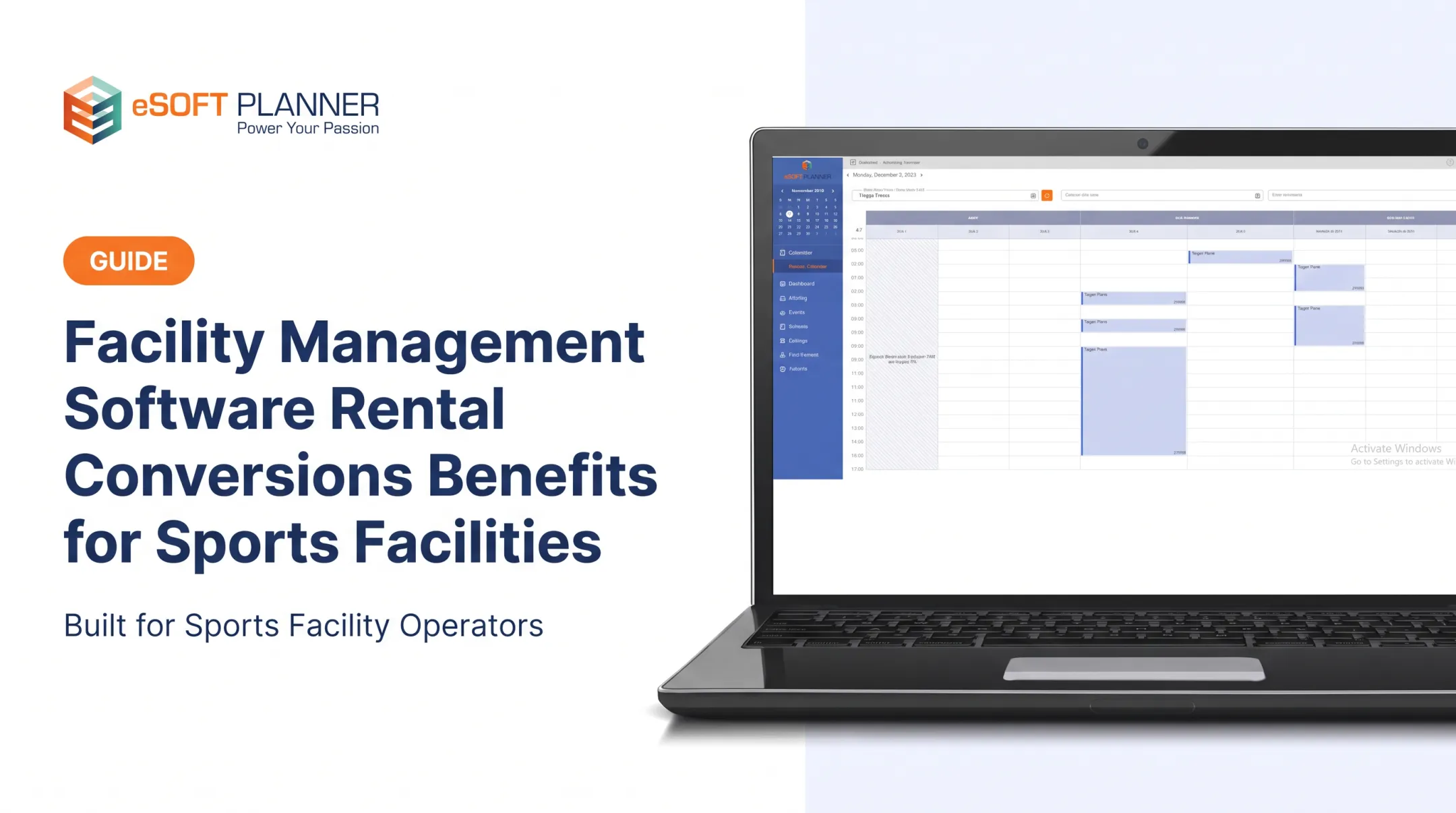
Choose technology for payments, customer records, communications, reporting, access control, and scheduling. A configurable platform such as eSoft Planner supports real-time online booking, reduces double-booking risk, and automates repetitive admin work.
Evaluate it during planning so your programs and capacity map onto the system. It can also require insurance documents and waivers before someone books.
After launch, review the plan regularly using these KPIs:
- Inquiries, conversion, and bookings
- Utilization by space and time
- Membership growth and retention
- Revenue by stream and average transaction value
- Labor cost and maintenance incidents
- Cancellations, satisfaction, and safety events
Booking data from a platform like eSoft Planner shows which spaces and time slots fill, which informs capacity and pricing decisions.
Frequently Asked Questions
How much does it cost to build an athletic facility?
Costs vary by facility type, size, location, property arrangement, fit-out needs, equipment, permits, professional fees, and working capital. Build a location-specific budget from vendor quotes and construction estimates instead of a universal figure.
How do I design a sports facility?
Start with target users, sports, capacity, safety, accessibility, traffic flow, storage, maintenance, spectators, and future flexibility. Work with qualified sports facility designers, architects, engineers, and local authorities.
What is a good business plan for a fitness center?
A solid plan covers the executive summary, market and competitor analysis, membership model, staffing, marketing, startup and recurring costs, projections, funding needs, risks, KPIs, and milestones.
What are the 4 Ps of sports marketing?
Product, price, promotion, and place. A facility should tie them to its programs, customer segments, competitive position, booking access, and retention strategy.
What is inside a sports complex?
Contents vary but may include courts or fields, training areas, reception, locker rooms, restrooms, storage, spectator seating, offices, concessions, retail, parking, and booking systems. Justify each feature through demand and financial feasibility.