
Facility managers deal with the same headaches on repeat: double-booked courts, thin staffing during peak season, maintenance that keeps getting pushed back, and margins that shrink every time something goes wrong. Add in the fact that nearly 90% of park and recreation agencies reported hiring or retention difficulty in 2023, and it's clear staffing isn't just an HR problem anymore. It's an operations problem.
This guide covers practical fixes across scheduling, staffing, maintenance, revenue, and technology.
Key Takeaways
- Automated booking systems eliminate double bookings and free front-desk staff from constant phone triage
- Clear staff roles and SOPs close coverage gaps and strengthen safety compliance
- Preventive maintenance protects equipment and prevents surprise downtime
- Diversified programming opens new revenue without adding prime-time court pressure
- Tight cash-flow processes and one connected platform keep scheduling, payments, and reporting in sync
What Does Sports Facility Management Involve?
Sports facility management covers the daily operations, maintenance, scheduling, staffing, and financial health of venues like sports complexes, swim clubs, and training centers. It spans booking coordination, event planning, safety compliance, and the customer experience from the moment someone walks through the door.
This applies across a wide range of facility types:
- Baseball and softball complexes
- Swim clubs and swim schools
- Cheer and gymnastics studios
- Dance studios
- Equestrian centers
- Tennis, volleyball, and multi-sport facilities
- Municipal parks and recreation departments
Each has its own quirks, but the operational bones are the same: get people scheduled correctly, keep staff coordinated, maintain the facility, and manage the money.
Master Scheduling and Booking Operations
Bad scheduling is one of the fastest ways to lose both revenue and customers. A double-booked field means a refund, an angry parent, and a staff member stuck smoothing things over instead of doing their actual job.
One documented example: a Ramsey, Minnesota recreation department reported spending 24 to 30 staff hours per week just coordinating reservations by phone before switching to management software, according to a CivicPlus case study. That's nearly a full-time job spent answering the phone.
Why Centralized Availability Matters
When courts, fields, pools, and instructors all live on separate calendars (or worse, a shared spreadsheet), conflicts are inevitable. A centralized system needs to:
- Show real-time availability across every space and program
- Validate instructor and facility availability simultaneously before confirming a booking
- Let managers block off maintenance windows so nothing gets booked over them
- Restrict which programs can use which spaces
This is the exact problem eSoft Planner was built to solve. Its founders ran a sports training facility themselves and got tired of forcing spreadsheets and generic calendar apps to do jobs they were never designed for.
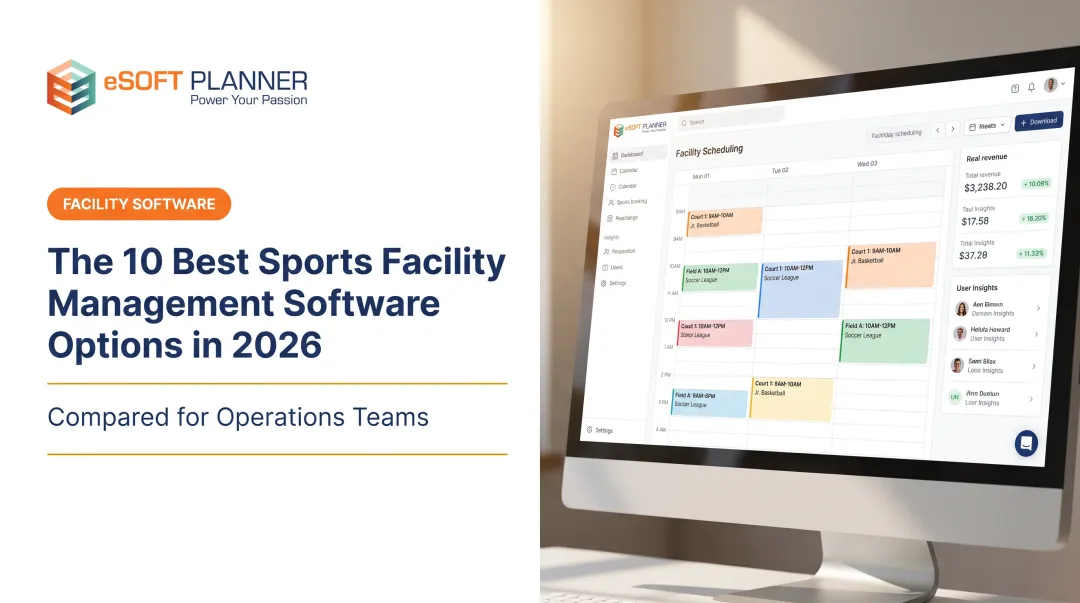
The platform centralizes lessons, instructors, and facility activities in one hub. It checks both space and instructor availability before confirming a booking, and lets customers self-serve with 24/7 online scheduling.
Once availability is centralized, automating recurring bookings (weekly practices, seasonal programs) means staff aren't re-entering the same appointment week after week. Pair that with clear cancellation policies and automated refund rules, and the back-and-forth phone tag mostly disappears.

Streamline Staffing and Daily Operations
Staffing shortages are an industry-wide reality. NRPA found that 97% of park and recreation agencies hired seasonal staff in 2023, and 56% had to pull permanent staff off their normal duties just to cover the gaps.
Clear roles, automation, and written procedures help you cover more ground with the team you already have.
Define Roles Clearly
Overlap and gaps both cause problems. Document front desk, coach, maintenance, and management responsibilities so coverage stays clear during shift changes and peak season.
For seasonal hires, a one-page role sheet beats a verbal walkthrough every time.
Automate the Repetitive Stuff
Staff shouldn't spend their shift manually chasing down invoices or typing attendance into a spreadsheet. Look for tools that automate:
- Invoicing and payment reminders (including expiring card notices)
- Attendance tracking via barcode scan or quick check-in
- Confirmation, reminder, and cancellation communications for both clients and instructors
eSoft Planner handles all three of these natively, freeing staff to actually be on the floor instead of behind a screen.
Build SOPs for Daily Routines
Written checklists for opening, closing, and event days remove guesswork:
- Opening checklist - equipment checks, safety walkthroughs, register setup
- Closing checklist - cash reconciliation, equipment storage, lockup verification
- Event-day protocol - staffing assignments, emergency contacts, crowd flow plan

Prioritize Maintenance and Safety Protocols
Preventive maintenance helps equipment run more efficiently and avoids costly failures. Regular lubrication, filter changes, and inspections beat waiting for something to break, according to Pacific Northwest National Laboratory's operations guidance.
Waiting for an HVAC unit to fail mid-August is not a strategy.
Build a Routine Inspection Schedule
Put these areas on a recurring checklist so small issues get caught before they force a shutdown:
- Playing surfaces for turf wear, court cracking, and pool tile damage
- HVAC systems ahead of peak heating and cooling seasons
- Lighting, especially outdoor field lights
- Safety equipment, including AEDs, first-aid kits, and fire extinguishers
Document Your Risk Management Plan
Every facility needs a written plan covering emergencies, injuries, and crowd safety. This isn't optional paperwork. It's what protects you legally and keeps staff calm when something actually goes wrong.
Know Your Compliance Requirements
Compliance varies by facility type and jurisdiction:
- ADA: Pools over 300 linear feet generally need two accessible entry points, per ADA.gov guidance
- Aquatic health: CDC's Model Aquatic Health Code recommends a qualified operator and ongoing preventive inspections while a pool is open
- Fire codes: Vary by local jurisdiction, covering exit routes, alarms, and extinguishers

Schedule regular audits with your local authority having jurisdiction rather than assuming last year's inspection still applies.
Diversify Revenue and Improve Profitability
Do sports facilities actually make money? It depends. There's no universal profit-margin benchmark, but seasonality is a real risk: the ABCA reports that some complexes see 70-80% of annual revenue land in just three to five months of good weather.
Profitability comes down to diversified revenue and controlling costs—not one silver-bullet program.
Expand Your Programming Mix
- Camps and clinics during off-peak seasons
- Private lessons
- Non-traditional sports like pickleball (85.7% participation jump in one year per SFIA)
- Party or event rentals during downtime
Tighten Cash Flow
- Online payment processing with recurring billing
- Membership tiers (6-12 month options, peak-time access perks, presale windows)
- Automated invoicing tied to your billing cycle, not manual follow-up
eSoft Planner's payment processing runs through Propelr Pay at a flat 3% rate with no annual fees, and the rate never changes. Membership tools let facilities presell a month before the season starts, so cash comes in before the first class runs.

Leverage Technology to Unify Operations
An all-in-one platform connects scheduling, payments, communications, and reporting so you're not toggling between five tools to answer one question. Staff see the same live schedule, membership, and payment data, which cuts double bookings and back-and-forth between front desk and managers.
Reporting That Actually Helps You Decide
Good dashboards should show:
- Check-in and occupancy data to guide staffing decisions
- Revenue and inventory tracking to inform pricing
- Peak-period and registration trends to shape program offerings
Scalable Pricing Matters
When you consolidate tools, the pricing model matters as much as the feature list. eSoft Planner's modular system includes 11 a la carte modules, from Team Management to Swim Club Management to Access Management, so facilities only pay for what they use. Pricing starts at $39/month and does not increase as you add customers, staff, or locations, so software cost stays predictable as the facility grows.
Frequently Asked Questions
What does sports facility management mean?
Overseeing operations, maintenance, scheduling, staffing, and safety so events and daily activities run smoothly—from booking coordination through compliance audits.
Do sports facilities make money?
Profitability depends on diversified revenue streams, efficient operations, and cost control with no guaranteed margin. Facilities with the right scheduling and payment systems in place manage seasonality and cash flow more successfully.
What software do sports facilities use to manage bookings?
Many use purpose-built scheduling platforms like eSoft Planner, which automate bookings, prevent double-booking conflicts, and reduce manual admin work. These differ from generic calendar apps by validating instructor and space availability together.
How can I reduce double bookings at my facility?
Use real-time online scheduling software with a centralized calendar covering every court, field, pool, and instructor. This removes the need for manual cross-checking across spreadsheets or separate calendars.
What skills does a sports facility manager need?
Strong time management, staff leadership, event coordination, and planning skills are essential. Managers also need comfort with basic financial oversight and compliance requirements specific to their facility type.
How often should sports facility equipment be inspected?
Run weekly visual checks plus monthly or seasonal preventive maintenance, adjusted for usage volume. High-traffic equipment like HVAC systems and pool filtration typically needs more frequent attention.