The difference between a productive practice and wasted field time often comes down to planning. While creating practice plans seems straightforward, results vary widely based on team age and skill level, available time, facility constraints, and how well the plan matches your team's developmental stage. A drill that works for high schoolers can overwhelm 10-year-olds, and a 90-minute plan that runs smoothly with 12 players can fall apart with 18.
This guide walks through the exact steps to create effective practice plans: how to set clear objectives, structure time efficiently, choose age-appropriate drills, incorporate competition, and avoid common pitfalls that kill momentum and engagement.
Key Takeaways
- Set 2-3 specific skill objectives per practice rather than trying to cover everything
- Use station rotations every 8-10 minutes to maximize repetitions and minimize waiting
- Allocate time strategically: roughly 50% defense, 30% offense, 20% situational play
- Build competition into every session to replicate game pressure and boost engagement
- Adjust plans continuously based on what's working and what needs improvement
Step 1: Define Your Practice Objectives and Goals
Every practice should target 2-3 specific skills or concepts, not everything at once. Trying to improve fielding, hitting, base running, situational awareness, and conditioning in a single 90-minute session guarantees rushed instruction and insufficient repetitions for meaningful improvement.
Start by identifying your team's most pressing needs:
- Recent games: struggled with relay throws last outing? Run a station on outfield-to-infield transitions
- Developmental gaps: give youth teams extra reps on throwing mechanics or fly-ball tracking before complex plays
- Position work: carve out specialized time for catchers and middle infielders outside full-team drills
Align that focus with where you are in the season:
- Pre-season: Fundamentals and conditioning (throwing mechanics, ground-ball progressions, arm strength)
- Mid-season: Refinement and strategy (double plays under pressure, approaches against different pitchers, defensive positioning)
- Late season: Game prep and mental readiness (situational execution, pressure reps, pre-game routines)
The National Fastpitch Coaches Association recommends putting your most important work first, when players are freshest. If bunt defense is the priority, schedule it in the first 20 minutes of skill work—not after fatigue sets in.
Step 2: Structure Your Practice for Maximum Repetitions
A well-structured practice keeps every player active, engaged, and getting quality reps. The biggest waste of practice time is athletes standing in line waiting for a turn.
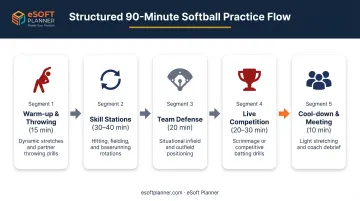
Break practice into distinct timed segments:
- Warm-up and throwing progression (15 minutes): Dynamic stretching, gradual long toss, and throwing drills that prepare arms without risking injury
- Skill stations (30-40 minutes): Rotate groups of 3-5 players through focused drills every 8-10 minutes
- Team defense (20 minutes): Full-field situational work with all positions engaged
- Live competition (20-30 minutes): Scrimmage situations or competitive drills that replicate game intensity
- Cool-down and team meeting (10 minutes): Static stretching, hydration, and brief review of what was learned
Station rotations keep players engaged. Instead of one drill with 15 players and 12 standing idle, create three stations of five. Every 8-10 minutes, groups rotate. One station fields ground balls, another hits off tees, and a third works base-running reads. All 15 players stay active at once.
Plan for assistant coaches or parent volunteers to run stations so you can move between groups and give individualized coaching. Coaching alone? Design stations players can run with little supervision after a quick demo:
- Mark drill areas with cones and bases
- Give a clear visual demonstration up front
- Assign a responsible player as station captain
Keep the tempo high. Strategic water breaks between segments are necessary, but transitions should take 1-2 minutes maximum. Players not actively participating in a drill should be retrieving balls, setting up the next station, or observing with a specific assignment ("Watch how her hips rotate on that swing").
Step 3: Design Age-Appropriate Drills and Stations
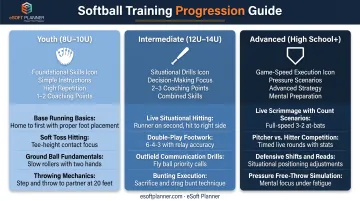
The same drill doesn't work for every age group. Youth players need repetition of fundamental movements with simple coaching cues, while advanced players need game-speed complexity and strategic decision-making.
Youth players (8U-10U): Focus on foundational skills with high repetition and 1-2 coaching points maximum per drill.
- Fielding: Ground balls rolled directly at them—ready position and glove down
- Throwing: Short-distance partner catch, proper grip and follow-through
- Hitting: Tee work and soft toss for contact points and bat path
- Base running: Running through first base; recognizing when to take an extra base
Keep instructions simple. "Glove down, butt down" beats a five-minute mechanics lecture. Demonstrations work better than long explanations for this age group.
Intermediate players (12U-14U): Progress to situational drills that combine skills and require decision-making.
- Fielding: Ground balls with feeds to bases, double plays, outfield relays
- Hitting: Live pitching with runners on, zone hitting, two-strike approaches
- Situational defense: Bunt coverage, first-and-third rundowns, cutoffs and relays
- Base running: Reading fly balls, secondary leads, sliding techniques
At this level, players can handle two or three related coaching points. "Field the ball, crow hop toward your target, follow your throw" connects the full sequence.
Advanced players (high school and above): Emphasize game-speed execution, advanced strategy, and pressure scenarios.
- Fielding: Full-speed fungo ground balls, game-speed double plays, diving and ranging plays
- Hitting: Live at-bats against quality pitching, situational contests, two-strike battles
- Situational play: Squeeze defense, multi-runner rundowns, pickoff plays
- Mental preparation: Pre-pitch routines, error recovery, pressure at-bats
For each segment (fielding, hitting, base running, situational play), pick 3-4 drills that match your objectives and can be explained in under 60 seconds. The NFCA's drill library and coaching packages offer dozens of tested progressions.
Vary drills every 2-3 practices to prevent boredom, but keep core work—ground ball progressions, tee work, throwing mechanics—consistent enough to build muscle memory. Players need repeated exposure, not a brand-new hitting drill every session.
Match drills to your facility and equipment:
- Keep indoor alternatives ready for bad weather
- Scale drills for limited space or shared field time
- Use full-field scrimmages when you have the diamond; run small-sided games in the outfield when the infield is occupied
Step 4: Implement Competition and Game-Like Situations
Competition transforms standard drills into higher-intensity training that replicates game pressure and decision-making.
Turn any drill into a competition by adding point systems, team challenges, or individual goals. A routine fly-ball drill becomes a competition when each outfielder earns a point for clean catches and loses a point for drops, with the winner choosing the next drill.
A base-running station becomes competitive when pairs race to see who reaches second base faster on a ground ball to the right side.
Dedicate the final 20-30 minutes of practice to live scrimmages or situational competitions:
- "21 Outs" drill: Offense gets 21 outs to score as many runs as possible; defense tries to hold them to the fewest runs
- Small-sided games: 6v6 on a smaller field with modified rules (such as opposite-field hits only, or mandatory slides)
- Offense vs. defense challenges: Set specific scenarios ("runner on second, one out") and award points for scoring the run or preventing it
Call out game situations during live play to develop softball IQ. "Runner on second, one out—what's the play on a ground ball to you?" forces the shortstop to verbalize the decision before the pitch, then execute under pressure.
Create accountability through practice consequences. The losing team runs sprints, the winning team picks tomorrow's warm-up music, or players track personal goals like batting average, fielding percentage, and stolen-base success rate across the season.
Research on contextual interference in motor learning shows that mixing conditions and adding pressure—once players can already execute a skill—improves retention and transfer to games.
What You Need Before Creating Practice Plans
Before you design drills, lock down three foundations: your season calendar, equipment and field access, and your roster.
Season-long practice calendar: Map out practice times, game schedule, and developmental milestones so each session fits your larger coaching strategy. Knowing you have 20 practices before your first tournament lets you spread skill progressions across weeks instead of cramming everything into one session.
According to experts cited by Little League, quality practices should outnumber games 2:1 to 4:1 because practice supplies more repetitions under lower pressure.
The American Academy of Pediatrics recommends at least one day off per week from all organized sport, and two to three months away from each sport annually, to prevent overuse injuries and burnout.
Equipment inventory and field access plan: Inventory what you already have and what you still need to acquire:
- Balls, bats, tees, cones, and bases
- Helmets, protective screens, and catcher's gear
- Confirmed field access windows plus indoor backup options for bad weather
USA Softball regulations require certified bats, approved balls, and specific protective equipment, including NOCSAE-approved face guards on youth helmets and proper catcher's gear.
Understanding of your roster: Player ages, skill levels, experience, positions, and limitations—injuries, scheduling conflicts—shape how you group players and design drills. A team with three experienced catchers can rotate catching duties during bullpens; a team with one catcher needs a backup plan when that player is absent.
Common Mistakes When Creating Practice Plans
Even solid practice frameworks fall apart when a few common mistakes creep in. Watch for these:
- Overly ambitious plans: Cramming hitting, defense, base-running, conditioning, and mental work into one 90-minute practice rushes teaching and starves every skill of reps. Limit each session to 2–3 objectives and run them well.
- Too much standing and waiting: If more than 2–3 players are in line, add stations or regroup. Six players taking one pitch each in a 10-minute hitting station get about 10 swings apiece—two groups of three doubles that to roughly 20.
- Skipping competition and fun: Practice should challenge players without becoming a grind. Games, challenges, and variety keep energy up so athletes show up ready to work.
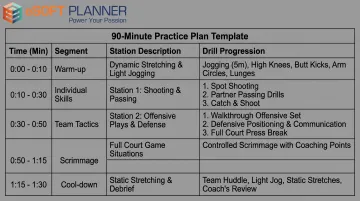
Sample Practice Plan Template: 90-Minute Session
This template balances skill development, team cohesion, and competitive intensity for intermediate players (12U-14U). Adjust times and complexity for younger or older athletes.
Total duration: 90 minutes
Warm-up and throwing progression (15 minutes):
- Dynamic stretching: leg swings, arm circles, high knees, butt kicks (5 minutes)
- Partner catch progression: short toss, gradual long toss to 90 feet, back to short distance (10 minutes)
Defensive stations—3 rotations of 10 minutes each (30 minutes):
- Station 1 (infielders): Ground ball progressions—forehand, backhand, slow rollers with throws to first
- Station 2 (outfielders): Fly ball tracking, communication drills, relay throws to cut-off positions
- Station 3 (all players): Double-play feeds and turns at second base, rotating through shortstop and second-base positions
Team defense and communication (20 minutes):
Full-field situational work with all positions. Coach hits fungos or uses live batting practice while calling out game scenarios:
- Runner on first, ground ball to shortstop—turn two
- Runner on second, fly ball to right field—hit the cutoff
- Bases loaded, bunt situation—execute coverage
Offensive station rotation—2 rotations of 7 minutes each (15 minutes):
- Station 1: Live hitting off pitching machine or coach, focusing on two-strike approaches
- Station 2: Tee work emphasizing opposite-field contact and line drives
Competitive situational game (20 minutes):
Offense vs. defense: set up runners on base (for example, runner on second, one out).
Offense scores a point for each run; defense scores a point for each out without giving up a run. Play to 10 points or until time expires. Losing side runs one sprint; winning side chooses tomorrow's music.
Cool-down and team meeting (5 minutes):
- Static stretching
- Hydration check
- Brief review: "What did we improve today? What do we work on tomorrow?"
Adapting this template:
- For 60 minutes: Cut one defensive station rotation (20 minutes) and reduce the competitive game to 10 minutes
- For 120 minutes: Add a second offensive station (base-running reads), extend team defense to 30 minutes, and lengthen the competitive game to 30 minutes
- For 8 players: Run two stations instead of three and rotate every 12-15 minutes to maintain engagement
- For 15+ players: Add a fourth station and use smaller groups (3-4 players per station) for higher individual repetition
When several teams share the same fields, booking gets messy fast. Facility tools like eSoft Planner let coaches reserve recurring practice slots online, avoid double-bookings, and push automatic reminders to staff and players.
Frequently Asked Questions
How long should a softball practice be?
Optimal length depends on age and attention span. Youth teams (8U–10U) do best at 60–75 minutes, intermediate teams (12U–14U) around 90 minutes, and high school or competitive travel teams about 2 hours.
How do you structure a 2-hour softball practice?
Use timed blocks: 15 minutes warm-up, 50–60 minutes defense (stations and team defense), 30–40 minutes offense (hitting stations and live at-bats), 20–25 minutes competitive situations or scrimmage, and 10 minutes cool-down and review. Put highest-priority work first while players are fresh.
What drills should be included in every softball practice?
Most practices should include throwing mechanics in warm-up, ground-ball fielding progressions, live hitting (tee, soft toss, or live pitching), and at least one competitive team drill or scrimmage that forces game-speed decisions.
How often should softball teams practice during the season?
Plan for 2-3 practices per week for youth and recreational leagues, 3-4 for competitive travel ball, and 5-6 for high school teams. Include at least one rest day per week to prevent burnout and overuse injuries, especially for pitchers who need recovery time between outings.
What's the best way to organize practice stations?
Group by position or skill level, rotate every 8–10 minutes, post clear drill instructions, and put an assistant coach or experienced player in charge of each station. Cone off stations and stage equipment before practice so transitions stay short.
How do you keep players engaged during practice?
Use competition and point systems, rotate drills often, give players clear roles, keep tempo high with little standing time, and close with a short competitive game. Track simple wins so players see progress each week.
Keep each plan simple: 2–3 skill goals, station work for reps, and a live competitive finish. Revise the next practice from what actually showed up on the field.