Here's the truth: batting cage efficiency isn't about swinging harder or taking more cuts. It's about having clear goals, structured sessions, and measurable progress every time you step into the cage. This guide covers pre-session planning, session structure, essential drills, progress tracking, and the common mistakes that waste your valuable practice time.
Key Takeaways
- Set specific goals before every cage visit—vague practice produces vague results
- Structure each session in three phases: warm-up, focused skill work, and game simulation
- Focus on quality repetitions with clear intent rather than mindless volume
- Track contact quality, swing mechanics, and pitch recognition instead of just counting swings
- Skip the killers: no plan, only practicing strengths, and skipping post-session review
Understanding Batting Cage Practice Efficiency
Practice efficiency means maximizing skill improvement per minute of cage time, not cramming in the maximum number of swings. Eighty focused, intentional swings with rest and feedback will develop your hitting far more than 200 swings on autopilot.
Why unstructured sessions backfire:
Repetition without intention doesn't build skill. It cements whatever pattern you're currently using, good or bad. Deliberate practice requires an explicit goal, active response, immediate feedback, and repeated attempts at an individualized difficulty level. Simply performing the same task every day is insufficient for developing expertise.
A 2017 study of 80 competitive high-school players found that adaptive, varied batting practice produced greater improvement than repetitive, fixed-condition practice on five of eight transfer measures. In those adaptive sessions, pitch type, speed, height, and location changed with performance. Challenge and variation matter more than sheer volume.
The three elements of efficient practice:
- Clear session objectives - Know exactly what you're working on before the first pitch
- Deliberate repetition with feedback - Take swings with purpose, get immediate input, adjust
- Measurable progress tracking - Document what worked, what didn't, and what to focus on next time
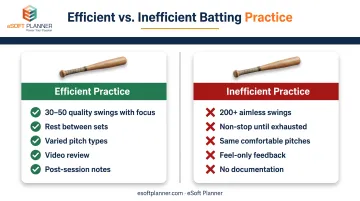
Efficient versus inefficient practice:
| Efficient Practice | Inefficient Practice |
|---|---|
| 30-50 quality swings with specific focus | 200+ swings with no clear purpose |
| Rest and analysis between sets | Non-stop swinging until exhausted |
| Varied pitch types and locations | Same comfortable pitch repeatedly |
| Video review and adjustment | "Feels good" as only feedback |
| Post-session notes for next time | No documentation or plan |
Pre-Practice Planning for Maximum Results
Arriving at the cage with a plan doubles your session's effectiveness. Without one, you'll default to whatever feels comfortable—usually the pitches and swings you already handle well—leaving weaknesses unaddressed.
Set Specific, Measurable Goals
Vague goals produce vague results. Replace "work on hitting" with concrete objectives:
- Improve contact on inside pitches
- Increase bat speed on fastballs
- Work opposite-field approach with two strikes
- Recognize and lay off breaking balls low and away
Pre-Practice Assessment Routine
Before you step into the cage:
- Review video from your last session - Identify one or two specific mechanical issues
- Pick 1-2 weaknesses to address - Don't try to fix everything at once
- Define success criteria - What does a successful session look like today?
Structure Pitch Settings and Time Blocks
Match pitch settings to your session goal:
- Slower speeds (50-60% of game speed) - Use for isolating mechanics and making technical adjustments
- Game speed - Use for timing work and building confidence
- Above game speed - Use sparingly to challenge reaction time once mechanics are solid
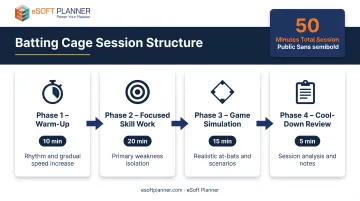
Then budget your cage time before you start:
- 10 minutes: Warm-up and rhythm work
- 20 minutes: Focused skill work on primary weakness
- 15 minutes: Game-situation simulation
- 5 minutes: Cool-down and session review
Coaches running this kind of structured work across multiple teams or private bookings need reliable cage availability. Scheduling software like eSoft Planner helps facilities lock in session blocks without conflicts or double bookings.
Structuring Your Batting Cage Session
A well-structured session follows a three-phase progression that mirrors how the body and brain learn motor skills.
Phase 1: Warm-Up (10-15 Minutes)
Start slow and build gradually:
- Dry swings - Focus on feel, rhythm, and key mechanical cues without a ball
- Slow-pitch contact work - Emphasize clean contact and proper swing path
- Gradual speed increase - Progress toward your working speed for the day
Research on 28 experienced female fastpitch players found that three 5-second maximal isometric contractions in the early swing position increased bat velocity by 4.93% six minutes later. While individual timing varies, a proper warm-up primes your nervous system for higher performance.
Phase 2: Skill Work (20-30 Minutes)
Build this block around one skill and short, focused rounds:
- Pick ONE primary focus - Stance, timing, pitch recognition, or another specific skill
- Run 3-4 short rounds - About 3-5 swings each; quality over quantity
- Rest and analyze between rounds - Review what you felt, saw, or recorded on video
- Make micro-adjustments - Apply one small change per round based on feedback
USA Baseball recommends keeping rounds short: no more than 5 swings per round, with 3-4 swings often more consistent. Single-swing rounds simulate game conditions most closely.
Phase 3: Game Simulation (10-15 Minutes)
Transfer your skill work into realistic at-bats:
- Create specific scenarios - 0-2 count, runner on third, two outs
- Practice two-strike approach - Shorten up, focus on contact quality over power
- Work on pitch selection - Make yes/no swing decisions, not just contact
Team Practices vs. Individual Sessions
Team practices need a rotation so nobody stands around. USA Baseball suggests:
- Groups of 3-4 hitters (5 maximum)
- Clear objective at each station: tee work, front toss, competitive rounds
Individual sessions allow deeper focus on personal weaknesses and longer uninterrupted work on specific adjustments.
Essential Drills That Improve Faster
Limited cage time rewards drills that transfer fast. These three progressions target the hitting problems that waste the most reps.
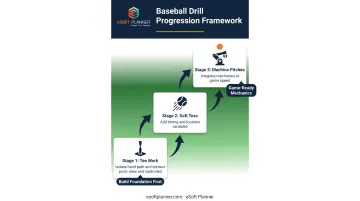
Tee to Machine Progression
Start each new focus area on a tee to isolate mechanics without the variable of pitch timing:
- Tee work - Dial in hand path, contact point, and swing plane
- Soft toss - Add timing and pitch location without high velocity
- Machine pitches - Integrate clean mechanics at game speed
Little League recommends this progression because tee work strips out speed and movement variables. Toss then adds timing and location, and machine or live-arm work merges those pieces under game-like speed.
Two-Strike Approach Drill
Run short cage rounds where every pitch is treated as two strikes:
- Shorten your swing slightly
- Widen your contact zone
- Prioritize quality contact over power
- Focus on putting the ball in play
A 2023 coaching case study used tee work, soft toss, and batting-practice games to rehearse two-strike execution, reporting that balls-in-play rates rose to approximately 80%.
Location-Specific Drill Series
Dedicate entire sets to specific pitch locations:
- Inside pitches only - Forces quick hands and proper hip rotation
- Outside pitches only - Develops opposite-field approach and patience
- High/low zones - Improves pitch recognition and discipline
Once a hitter handles one zone cleanly, mix locations instead of staying blocked. USA Baseball's six-zone decision training randomizes location, count, and pitch type to stress adjustment and recognition under tighter cage time.
Tracking Progress and Adjusting Your Approach
Measuring improvement separates serious hitters from casual cage users. Specific data drives progress; vague feelings don't.
Track the Right Metrics
Focus on measures that predict game performance:
- Hard-contact percentage - How often do you square the ball up?
- Swing path consistency - Are you repeating your best swing?
- Pitch recognition accuracy - Can you identify pitch type and location early?
- Exit velocity and bat speed - Are your baseline numbers improving over weeks?
USA Baseball also flags situational execution and target-tee outcomes as useful practice measures alongside these metrics.
Use Video for Week-Over-Week Comparison
Record key portions of each session. A 2022 systematic review found video feedback generally more effective than verbal feedback alone. Compare mechanics from this week to last week, not just swing to swing, to spot real trends versus random variation.
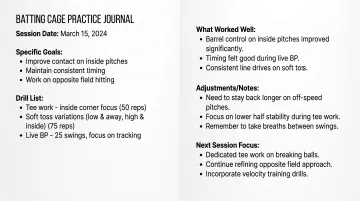
Keep a Simple Practice Journal
Document every session in a notes app or notebook:
- Session date and goal
- What drills you used
- What worked well
- What needs adjustment
- Focus for next session
This creates accountability and reveals patterns you'd otherwise miss. Motor learning research distinguishes between temporary session performance and sustained learning; your journal helps you track true retention and transfer.
Common Efficiency Mistakes to Avoid
Even motivated players waste cage time. Here are the biggest efficiency killers.
The Volume Trap
Taking 200+ mindless swings reinforces bad habits faster than it builds good ones. Research shows that adaptive, varied practice with 30 pitches per session over six weeks outperformed high-volume, unchanging repetition. Quality and challenge matter more than quantity.
Practicing Only Your Strengths
Hitting pitches you already handle well creates false confidence. Practice-specificity research found that improvement was strongest against practiced speeds and pitch types. You get better at what you practice, not at what you avoid. Devote at least half your skill-work time to weaknesses.
Skipping Cool-Down and Analysis
Five minutes reviewing what worked and what needs adjustment sharpens your plan for the next visit. Skip it, and you repeat the same session and the same mistakes every time you step in the cage.
Continuing Through Severe Fatigue
Laboratory research shows that practicing while severely fatigued can create lasting impairment in motor learning. When focus and mechanics degrade, stop. Low-quality repetitions teach your nervous system the wrong pattern.
Frequently Asked Questions
How long should a batting cage practice session last?
Individual sessions should run 45-60 minutes. Quality and focus decline after an hour. Team practices can extend to 60-90 minutes when rotation systems keep players engaged and limit idle time.
How many swings should you take in a batting cage session?
Aim for 80-120 high-quality, focused swings with rest and analysis between sets. This produces better results than 200+ mindless swings. USA Baseball recommends short rounds of 3-5 swings to maintain focus and simulate game conditions.
What's the best way to track progress in batting cage practice?
Combine weekly video of your mechanics, hard metrics like contact quality and exit velocity, and a short practice journal of goals and drills. Together they show both what changed and what still needs work.
Should you practice in a batting cage every day?
No. Three to four focused sessions per week are more effective than daily practice. Rest allows physical recovery and mental processing of mechanical adjustments. Distributed practice with rest intervals improves motor learning compared to massed daily repetition.
How do you prevent bad habits from forming in batting cage practice?
Focus on deliberate practice with specific goals, review video regularly, seek periodic coaching feedback, and avoid high-volume mindless swinging. Deliberate practice principles emphasize active engagement, immediate feedback, and cognitive effort—not passive repetition.
What's the difference between batting cage practice and live pitching practice?
Batting cages excel at mechanics work, isolated skill development, and high-repetition training. Live pitching adds pitch deception, velocity variation, sequencing, and game-speed decision-making. Both are necessary: cages build the foundation, live pitching tests it under realistic conditions.