
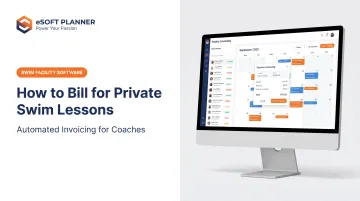
This guide covers the essential components of professional swim lesson billing: choosing the right billing model, setting competitive pricing, selecting payment methods, creating enforceable policies, building a professional invoicing system, and leveraging software tools that eliminate administrative friction.
Key Takeaways
- Pick per-lesson, package, or monthly billing based on cash flow needs, client flexibility, and admin workload
- Set prices from your costs, experience, location, and market position, not competitor averages alone
- Automated payment collection reduces late payments and saves hours of manual follow-up each week
- Clear written policies for due dates, late fees, cancellations, and make-ups prevent disputes and protect revenue
- Billing software cuts manual invoicing, links scheduling to payments, and gives clients self-service portals
Understanding Your Billing Model Options
Per-Lesson Billing
Per-lesson billing lets clients pay for each lesson at booking or right after the session. Clients commit only to what they book, with no packages or recurring charges required.
Pros:
- Low barrier to entry attracts new clients who want to try before committing
- Easy to pause or change frequency without penalties
- No refund complications when clients stop lessons unexpectedly
Cons:
- Unpredictable cash flow makes it harder to forecast monthly revenue
- Higher admin load: every lesson needs its own invoice and payment
- Increased no-show risk since clients haven't prepaid
- More time spent chasing payments after each session
Monthly Subscription Billing
When you want steadier income than pay-as-you-go, monthly subscriptions charge a flat recurring fee for a set number of weekly lessons. For example, $300/month covers four 30-minute sessions, billed automatically on the first of each month.
Recurring billing supports more consistent cash flow and clearer revenue forecasts, which helps when you plan pool rentals or hold schedule blocks. The tradeoffs are real: you still maintain billing, fight churn, and risk cancellations when progress stalls.
Pros:
- Predictable monthly revenue simplifies budgeting and expense planning
- Cuts admin work to one invoice per client per month instead of four to eight
- Stronger retention through commitment and habit formation
- Lower processing fees with monthly ACH transfers
Cons:
- Upfront commitment can deter casual learners
- Unused lessons from vacations or illness create billing friction
- Clear cancellation and make-up policies are essential to prevent disputes
Package Billing
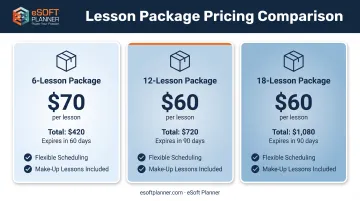
Package billing sits between the two: sell lessons in bulk at a discount—for instance, 10 lessons for $400 when singles run $45 each. Many swim schools tier this way, such as $70 per session in a six-lesson pack and $60 per session in 12- or 18-lesson packs for 30-minute private lessons.
When this model works best:
- Committed clients who still want more flexibility than a monthly plan
- Seasonal instructors locking in revenue before peak summer
- Multi-week programs like stroke clinics or competitive technique courses
How to structure profitable packages:
- Discount 10–20% off per-lesson rates while still covering costs
- Set 60–90 day expirations to keep attendance consistent
- Require full payment upfront to secure cash flow
- Tier discounts so larger packages earn a better per-lesson rate
Setting Your Pricing Strategy
Factors That Impact Pricing
Swim lesson pricing varies widely based on instructor qualifications, operational costs, and local market dynamics. Key variables include:
- Instructor experience and certifications — WSI, YMCA, CPR/First Aid, infant survival, or competitive coaching credentials support higher rates
- Lesson location — Pool rentals, travel time, facility access rules, and parking all hit your margins
- Lesson duration — Price 15-minute infant sessions, 30-minute standards, and 60-minute stroke clinics on separate structures
- Group vs. private — A private slot shared by two or three matched swimmers changes your effective rate per child
- Geographic market rates — Urban, higher cost-of-living areas usually support higher prices than rural or suburban markets
Competitive Pricing Analysis
Once you know your cost drivers, research local competitors before you lock in rates:
Research sources:
- Swim school websites in your service area
- Recreation center and YMCA program schedules
- Online lesson marketplaces (Thumbtack, Care.com, local Facebook groups)
- Direct calls to three to five competitors posing as a potential client
Positioning based on unique value:
- Specialized certifications — Infant survival, adaptive aquatics, or competitive technique can justify 20–30% premiums
- Convenience — Early morning (6–7 AM), late evening (7–9 PM), or weekend slots command higher rates
- Proven results — Progress tracking, video analysis, or milestone guarantees support premium pricing
- Location advantages — In-home instruction saves families travel time and can cut your facility rental costs
Calculating Your Costs
Before setting prices, calculate your true cost per lesson:
Fixed monthly costs:
- Pool rental fees or facility memberships
- Liability insurance ($300–$800/year)
- Business licenses and certifications
- Software subscriptions for scheduling and billing
Variable per-lesson costs:
- Travel time and mileage (use the current IRS rate — $0.70/mile in 2025)
- Equipment (kickboards, pull buoys, training aids)
- Payment processing fees (2.6–3.5% per transaction)
Administrative time:
- Scheduling and confirmation (5–10 minutes per lesson)
- Invoicing and payment follow-up (5–15 minutes per lesson)
- Progress tracking and parent communication
Scheduling and billing software (such as eSoft Planner) can shrink that admin block so more of each fee stays as profit.
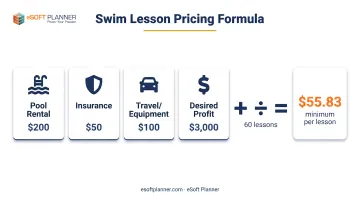
Minimum viable pricing formula: (Total Monthly Costs + Desired Monthly Profit) ÷ Expected Number of Lessons = Minimum Price Per Lesson
Example:
- Monthly pool rental: $200
- Insurance: $50/month
- Travel/equipment: $100/month
- Desired profit: $3,000/month
- Expected lessons: 60/month
($200 + $50 + $100 + $3,000) ÷ 60 = $55.83 minimum per 30-minute lesson
Premium Pricing Strategies
After you clear your minimum rate, charge more where expertise or convenience is clearly scarce—without re-listing every certification you already priced above.
High-demand add-ons:
- Underwater video analysis with stroke correction ($20–$30 per session)
- Written progress reports every four weeks
- Parent observation sessions with coaching tips
- Sibling group rates that still protect per-student margin
Scarce time slots worth a premium:
- Before-work lessons (5:30–7 AM)
- Weekend prime time (Saturday 9 AM–12 PM)
- Holiday or vacation-week availability
- In-home pool instruction when families will pay to skip the drive
Seasonal and Promotional Pricing
Use promotions to fill the calendar in slow months and lock in commitment before peak season:
Peak summer demand (May–August):
- Raise rates 10–15% during highest-demand months
- Require advance booking and deposits to secure prime slots
- Offer limited early-bird discounts for clients who book in March or April
Off-season enrollment drives (September–April):
- Discount packages: "Buy 10 lessons, get 2 free" (September–November)
- Referral incentives: $25 credit for every new client referred
- Sibling discounts: 10% off the second child, 15% off the third
- Early-registration deals: "Book January in December and save 15%"
Long-term commitment incentives:
- Three-month prepay: 10% off total
- Six-month commitment: 15% off plus waived registration fee
- Annual membership: unlimited monthly lessons at a lower per-lesson cost
Set rates you can defend, then bill them the same way every time—clear packages, written policies, and automated invoices keep pricing strategy from leaking profit.
Choosing Payment Methods and Policies
Payment Method Options
The Federal Reserve's 2025 Diary of Consumer Payment Choice found that, by transaction count in 2024, credit cards represented 35% of U.S. consumer payments, debit cards 30%, and cash just 14%. Most families expect to pay for swim lessons the same way they pay for other services: electronically.
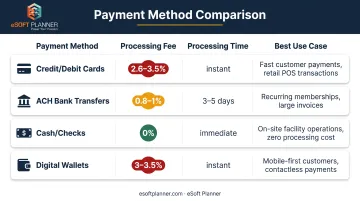
Credit and debit cards:
- Pros: Convenient, secure, widely expected, enables recurring billing
- Cons: Processing fees (2.6-3.5% depending on provider)
- Typical fees: Stripe charges 2.9% + $0.30 per online transaction; Square charges 2.6% + $0.15 in person and 3.3% + $0.30 for invoices
ACH bank transfers:
- Pros: Lower fees (0.8-1% vs. 2.9-3.5%), ideal for recurring monthly charges
- Cons: Slower processing (3-5 business days), higher failure rate for insufficient funds
- Typical fees: Stripe ACH is 0.8% capped at $5; Square invoice ACH is 1% with $1 minimum
Cash and checks:
- Pros: No processing fees, immediate availability (cash)
- Cons: Manual tracking, no automatic recurring option, security risk, time-consuming deposits
- Best for: Clients without bank accounts or credit cards, one-time registration fees
Digital wallets (Venmo, PayPal, Zelle):
- Pros: Fast, familiar to younger parents
- Cons: Less professional, inconsistent business protections, unclear tax reporting
- Typical fees: PayPal business transactions cost 2.99% + fixed fee; Venmo business charges 3.49% + fixed fee
Automated vs. Manual Payment Collection
How you collect matters as much as which methods you accept.
Automated recurring billing:
- Set up once; charges the client's saved payment method each month
- Cuts late payments and removes manual follow-up
- Needs a processor or swim-school management platform with recurring billing (Stripe, Square, or similar)
Manual invoicing:
- You send an invoice after each lesson or at month-end
- Client pays online or by mail
- More control per transaction, but slower and easier to forget
Cash flow reality: Automated billing typically collects 5-7 days faster than manual invoicing and can cut admin time by 60-80% per cycle. Xero reports online invoice payments can arrive up to 2x faster than traditional methods, though that figure is a vendor claim, not independent swim-instructor research.
Creating Clear Payment Policies
Put these essential terms in writing before the first lesson:
Core policy elements:
- Payment due dates: "Payment due upon booking" or "Monthly subscription billed on the 1st, payment due by the 5th"
- Accepted payment methods: List all options (credit/debit, ACH, cash) and default preference
- Late payment fees: "Payments more than 7 days overdue incur a $15 late fee or 5% of invoice, whichever is greater" (verify your state's usury limits)
- Insufficient funds fees: "$25 fee for returned payments; service suspended until balance cleared"
- Grace periods: "3-day grace period before late fees apply"
Where to communicate policies:
- Include full payment terms in your service contract
- Post billing policies on your website's FAQ page
- Send policy summary in welcome email after registration
- Review key terms during initial consultation or assessment
Handling Late Payments and Non-Payment
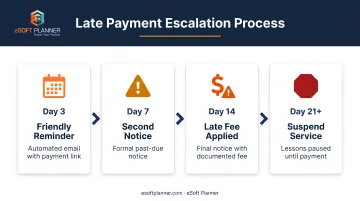
Written policies only work if you enforce them the same way every time. Use a simple escalation ladder:
| Days overdue | Action | Message focus |
|---|---|---|
| 3 | Friendly automated reminder (email or text) | Amount, original due date, easy pay link |
| 7 | Formal second notice | Past-due status, pay-by date, late-fee warning |
| 14 | Apply documented late fee + final notice | Balance with fee, suspension date if unpaid |
| 21+ | Suspend lessons until balance is cleared | Payment plan, reduced settlement, or closure options |
Keep every notice professional:
- Stay respectful and factual; skip guilt language
- Point back to your written agreement in each message
- Offer a short payment plan when hardship is temporary
- Log every contact for disputes or chargebacks
Creating a Professional Billing System
Essential Invoicing Elements
Every professional invoice should include the components below (aligned with Square's invoicing guidance):
Required fields:
- Your business name, contact information, and logo
- Client's name and contact details
- Unique invoice number (sequential: 001, 002, 003...)
- Invoice date and specific payment due date
- Itemized services with dates, lesson type, duration, and rate
- Subtotal, taxes (if applicable), discounts, and total amount due
- Accepted payment methods and instructions
- Late fee terms and grace period
How the invoice looks matters as much as what it lists:
Professional presentation:
- Use branded invoice templates with your logo and colors
- Clear, easy-to-read formatting with organized line items
- Professional language (avoid casual phrasing)
- Mobile-friendly layout for clients who view on phones
Establishing a Billing Schedule
For monthly subscription billing:
- Bill on a consistent date each month (1st or 15th work best)
- Allow 3-5 business days for processing before charging
- Example: Invoice sent on the 1st, payment processed on the 5th if not received
- Automate renewal unless client cancels with required notice (typically 7-14 days before next billing cycle)
Per-lesson billing follows a different cadence:
For per-lesson billing:
- Payment at booking: Client pays when scheduling the lesson (recommended for new clients or those with payment history issues)
- Payment after completion: Invoice sent immediately after the lesson, due within 24-48 hours (suitable for established clients with good payment records)
Choose based on cash flow needs and client reliability. Payment-before-service reduces no-shows and guarantees revenue.
Registration Fees and One-Time Charges
Registration fees cover administrative setup time, initial client assessment, onboarding paperwork, and system configuration. Individual providers charge anywhere from $30 one-time (Florida Swim Company) to $45 annual (Swim School Austin).
Purpose of registration fees:
- Offset time spent on intake forms, liability waivers, and skill assessments
- Cover software setup, client portal access, and initial scheduling
- Signal commitment and reduce last-minute cancellations
- Create barrier to serial "first lesson" shoppers
Common ways to structure the fee:
Typical structures:
- One-time: $25-$50 charged once when client first enrolls
- Annual: $35-$60 charged each calendar or program year
- Per student: Separate fee for each family member or sibling
Prorated Billing for Mid-Cycle Enrollments
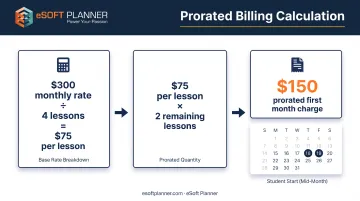
When a client enrolls mid-month in a monthly subscription model, calculate the prorated charge:
Formula: (Monthly Rate ÷ Number of Lessons in Month) × Remaining Lessons = Prorated Charge
Example:
- Monthly subscription: $300 for four weekly lessons
- Student starts on the 15th with two of four lessons remaining
- $300 ÷ 4 × 2 = $150 prorated charge for first month
- Full $300 charge begins the following month
Stripe's subscription billing system automatically prorates between signup and the first full billing cycle unless you disable the feature. Always show clients the calculation on the first invoice: both the full monthly rate and the prorated amount.
Handling Make-Up Lessons and Cancellations in Billing
Unclear make-up policies create more billing disputes than any other issue. Establish these rules before the first lesson:
Advance notice requirements:
- 24-hour notice: Client receives make-up credit
- Less than 24 hours: No make-up credit, full lesson fee charged
- Instructor cancellation: Automatic make-up credit, no charge
Set a clear window so credits do not pile up indefinitely:
Make-up expiration periods:
- Credits valid for 30-60 days from original lesson date
- Unused credits expire and cannot be refunded
- Maximum one make-up lesson per calendar month (prevents indefinite accumulation)
Monthly plans need an extra rule for how make-ups interact with the included lesson count:
Monthly subscription considerations:
- Decide whether make-ups count toward the monthly lesson total or are additional
- Example policy: "Monthly subscription includes four lessons plus one make-up allowance per month; additional make-ups not provided"
- Alternative: "Make-ups scheduled within 30 days do not reduce monthly payment; unused make-ups are forfeited"
Translate those rules into how invoices actually change:
Billing implications:
- Credits: Issue account credit that appears on next invoice, reducing balance
- Scheduled make-ups: Track separately without financial adjustment
- Included make-up allowance: Price monthly subscription to absorb occasional make-ups without per-instance adjustments
Billing Software and Tools for Swim Instructors
Manual invoicing, spreadsheet tracking, and separate scheduling calendars create hours of repetitive work each week. Specialized billing software eliminates these inefficiencies by connecting scheduling, invoicing, payment processing, and client communication in one system.
Why swim instructors need integrated billing software:
- Eliminates manual invoice creation after every lesson
- Automatically sends payment reminders and processes recurring charges
- Provides online booking so clients can schedule and pay 24/7
- Tracks client payment history, outstanding balances, and lesson credits
- Cuts hours of weekly admin compared with spreadsheets and separate tools
eSoft Planner is built for activity-based businesses like swim instruction. It ties lesson scheduling, recurring billing, card and ACH payments, client portals, make-up tracking, and reporting into one system.
Plans start at $39/month with à la carte modules, so you pay only for what you use. Core capabilities include:
- Automated monthly billing without hand-built invoices
- Real-time payment tracking for paid vs. outstanding balances
- Online registration and payment so clients book without email back-and-forth
- Revenue reports for cash flow and growth planning
Essential features to look for in billing software:
- Online booking that lets clients schedule and pay in one step
- Invoices and payment reminders sent on your schedule before due dates
- Card, ACH, and other methods without juggling separate processors
- Client portals for invoices, history, and self-serve payments
- Live reporting on revenue, balances, and collection rates
Frequently Asked Questions
How much should I charge for a 30-minute swim lesson?
Private 30-minute lessons typically run $30–$75 based on experience, certifications, location, and local demand. Check a few nearby competitors, cover your per-lesson costs, then price for your value. Specialized certs or in-home convenience support rates at the high end.
Do swim lessons count as child care expenses for tax purposes?
Generally, no. Under IRS Publication 503, qualifying expenses must be for care that lets a parent work, not stand-alone education or recreation. Parents should ask a tax pro; do not market lessons as automatically eligible child-care expenses.
Should I require payment before or after lessons?
Require payment before service, at booking or at the start of each subscription month. Prepayment improves cash flow, cuts no-shows, and is standard for swim schools. A first-lesson money-back guarantee can ease hesitant clients.
What should I do if a client disputes a charge?
Review the signed agreement and invoice with the client, stay professional, and point to your written pricing and cancellation policies. Aim for a fair fix (make-up credit or waived fee) and document it. For chargebacks, reply by the issuer deadline with the contract, attendance, and proof of service.
How do I handle refunds for canceled lessons?
Put the refund rules in your contract before you take payment. Common approach: subscriptions end at the period close with no mid-cycle refund; packages get prorated unused lessons only with enough notice; client no-shows are non-refundable. Prefer make-up credits over cash when you can.
What billing information should I include in my contract?
Spell out every billing term so disputes are rare:
- Pricing model and payment schedule
- Accepted methods, due dates, and late/NSF fees
- Cancellation notice, refunds, and make-up limits
- Auto-renewal and any registration fees Have clients sign and keep a copy; reference the contract on invoices.